Blog
Estimated reading time: 9-13 minutes. Last updated on 29/09/2026
This blog looks at how to choose the best hernia surgeon in Bristol for your specific needs. It introduces you to some of the Practice Plus Group specialists, explores the different types of hernia surgery on offer, and looks at what to expect from a hernia consultation.

Private hernia repair surgery at a glance
- Waiting time: 4-6 weeks
- Cost: £3,449
- Ways to pay: self-pay, via insurance, or payment plans
On this page:
A Consultant General Surgeon who specialises in hernia repair does so via either open or keyhole surgery. These reinforce weakened abdominal muscles with mesh to prevent recurrence.
This article explains how to choose a qualified general consultant in Bristol, outlines common hernia types and treatment options, and describes what patients can expect during consultation, surgery, and recovery at Practice Plus Group Hospital, Emersons Green.
What does a hernia surgeon do?
A hernia surgeon carries out hernia repairs. These procedures usually involve pushing abdominal tissue back into place through a gap in the abdominal wall muscles. He or she may do this via open surgery to repair the hernia or using the keyhole method which involves passing a camera and surgical tools through smaller incisions to perform the surgery. The affected area is then reinforced with a surgical mesh.
The role of a hernia surgeon vs a general surgeon
A hernia surgeon is typically also a general surgeon. This just means that these medical professionals have an interest in hernia surgery and are able to carry out a range of different hernia-related procedures. At Practice Plus Group, our general surgeons in Bristol can perform the following treatments and do so on a regular basis:
- Benign skin lesion removal
- Haemorrhoids treatment
- Gallbladder removal
- Anal fissure surgery
- Pilonidal sinus treatment.
What is a hernia and how does it develop?
A hernia occurs when an internal part of the body – often fatty tissue or part of the bowel – pushes through a weakness in the surrounding muscle. Hernias can occur anywhere on the body but are most common between the chest and hips. The most common types of hernias are the inguinal (where fatty tissue or bowel pokes through into the groin area) or umbilical (where fatty tissue pushes into the belly button area).
Hernias cause symptoms such as discomfort in the area. If left untreated, they can cause more serious problems such as strangulation. Signs that a hernia has developed include:
- a lump in the affected area
- discomfort.
Selecting the right hernia surgeon in Bristol
Choosing the right hernia specialist in Bristol can feel a little overwhelming at first but worry not – you’ve come to the right place for help. The information featured below shows you what to look for in a specialist, introduces you to the available hernia surgeons in Bristol, and provides further reading on the subject.
Checking qualifications, GMC registration, and experience
Regardless of what surgery you’re having, consultant qualifications and experience are vital. You should look for consultants registered with the General Medical Council (GMC) as well as specialty-specific organisations like the Royal College of Surgeons or the Private Healthcare Information Network (PHIN).
You can check our consultants’ experience by viewing their online profiles. Simply use the carousel below to cycle through those available or take a look at our general surgery consultants page. These profiles show how many years’ experience each consultant has in the field of general surgery, the number of procedures they perform annually, and the areas of general surgery they specialise in.
Why hernia subspecialisation matters
Hernia subspecialisation matters because it allows hernia care to be tailored. This helps to improve patient outcomes and surgery success rates while helping to reduce the rate of complications. All our Bristol-based general surgeons specialise in hernia repair surgery and carry out a large number of hernia procedures each year. In fact, studies show that the complication rate of hernia procedures is lower if the surgery has been carried out by surgeons with a track record of carrying out regular hernia repairs. In other words, practice very much makes perfect!
Patient experiences with Bristol hernia surgeons
One of the best indicators of trust and credibility is word-of-mouth, and what better way to see this than through the experiences of our patients. The excerpts below are from past hernia surgery patients at Practice Plus Group Hospital, Emersons Green.
Reviews on surgeon expertise and care
The following patient reviews highlights the attention-to-detail and caring nature of the staff at Practice Plus Group Hospital, Emersons Green, particularly focusing on Paula Sabino dos Santos, our consultant general surgeon who specialises in hernia repair, gallbladder removal, and haemorrhoid treatment:
“Staff at assessment were very reassuring and professional, especially Ms Paula Sabino dos Santos who explained everything perfectly. On the day of surgery, reception staff were very friendly and efficient. Pre and post-op was looked after by Ms Amparo Herrero-Canovas – absolutely lovely and caring, nothing was too much trouble for her. Cannot fault the hospital or staff, they couldn’t have done any more to make me feel more calm or comfortable.”
Michael Wilson, hernia repair surgery patient at Practice Plus Group Hospital, Emersons Green
“I then met consultant surgeon Paula Sabino Dos Santos who immediately put me at ease and spoke in the language I understood. She was very thorough and I was very confident and happy with her, particularly as she was happy to perform the surgery herself.”
Neil Fisher, hernia repair surgery patient at Practice Plus Group Hospital, Emersons Green
Common types of hernias treated in Bristol
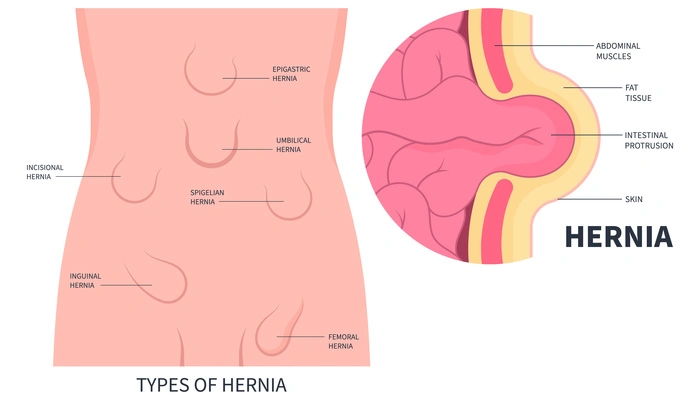
According to the NHS, the most common type of hernia treated across the UK is inguinal.1 But regardless of the most common, the following types of hernia can be treated at Practice Plus Group Hospital, Emersons Green:
- Inguinal
- Umbilical
- Femoral
- Incisional
- Ventral (or Epigastric)
- Spigelian
The illustration below outlines where on the body these hernias occur, while the sections that follow delve deeper into the details of the different types.
Inguinal hernia and groin pain
Inguinal hernias occur when fatty tissue (or sometimes part of your bowel) pokes through into your groin area (or inguinal canal). This type of hernia is more common in men and is associated with repeated strain on the abdomen. Inguinal hernia surgery is usually straightforward; people are able to return home the same day of their procedure. The surgery itself takes between 40 – 60 minutes.
Umbilical hernias
Umbilical hernias are a type of ventral hernia and occur near the belly button. As with the other types of hernia, they are typically made up of fatty tissue or part of the bowel that pushes through a weak spot in the abdominal wall near the belly button. They often occur around this area because it’s a common weak spot; the place where we all were attached by the umbilical cord in the womb. Umbilical hernia surgery is a straightforward procedure and takes around 20 minutes.
Femoral and incisional hernias
Femoral hernias are less common than inguinal but present in similar ways. Typically, they occur when fatty tissue or intestine pokes through a weakened part of the abdominal wall around the inner thigh. This type of hernia affects more women than men (but the most common hernia to occur for women is inguinal).
Incisional hernias present in the same way as other types (tissue or organs protruding through weakened areas of muscle) as a result of previous surgical incision. Incisional hernias can be challenging to treat at times, and the operation can take much longer than other types.
Understanding hernia surgery options
Hernia surgery is performed in one of two ways: keyhole or open. While there are benefits and disadvantages when it comes to both surgical techniques, the type of surgery you have will depend on your specific case. For example, laparoscopic (keyhole) hernia repair offers faster recovery rates due to the smaller incisions made. However, not everyone will be suitable for this type of surgery and it is more complicated than the open technique.
Your consultant will be able to recommend the best course of action for you.
Open vs laparoscopic hernia repair
Let’s start with open surgery. During open hernia surgery, your surgeon will make an incision over your hernia. He or she will then push the protruding tissue back through the muscle. This area of weakened muscle will have mesh either glued or stapled to it to help reinforce the area. The wound is then closed with stitches.
With regards to laparoscopic hernia repair (also called keyhole surgery), this involves a surgeon using an instrument called a laparoscope (a thin, rigid telescope with a light). The laparoscope (and any specialised tools the surgeon needs) is passed through the abdominal wall via small incisions and then the hernia is pulled back into place, the defective in the muscle is closed and then a mesh applied.
What to expect at your initial consultation
If you’ve got a hernia (or suspect you may have one) and need advice from one of our specialists, booking an initial consultation is a good idea. They take around 20 minutes and are designed to conclude with a diagnosis and treatment plan tailored to your specific needs. For the majority of patients, by the end of a consultation your specialist will be able to tell you if you need surgery, however, in some cases scan(s) may be required. This is to help the consultant arrive at the best treatment option for you.
A consultation is also your opportunity to ask questions and learn more about your condition and proposed treatment.
The information below digs deeper into what happens at a hernia consultation.
Medical history and physical examination
As the main aim of a consultation is to arrive at a diagnosis, your consultant will need to carry out a physical examination – so it’s a good idea to wear loose-fitting, comfortable clothes. He or she will also ask you about your general health and any pre-existing conditions you have.
Scans, imaging, and diagnosis
It’s possible that, during the course of your consultation, the specialist may need to lean on the help of diagnostic imaging and scans. This is to help ensure the diagnosis is accurate. Please note that, for private patients, CT and ultrasound scans will incur extra cost.
Discussing treatment options and next steps
Once your consultant arrives at a diagnosis, he or she will devise a treatment plan that’s tailored to your specific condition and needs. This plan will be clearly explained to you and you’ll have the opportunity to ask questions about what to expect from your treatment.
Once the appointment is over, you can return home. If you had your consultation with us, our booking team will be in touch within a couple of days to arrange a time and date for your treatment at a time that suits you.
Why choose Practice Plus Group for your Bristol hernia surgery?
All of our Consultant General Surgeons at Practice Plus Group Hospital, Emersons Green have a wealth of experience carrying out hernia repair surgery on a regular basis, treating a large number of patients each year.
We offer both keyhole and open repair procedures depending on the most appropriate option for the patient.
Want to access hernia repair surgery via private medical insurance?
Simply type in the name of your insurance provider below to see if you can access healthcare with us.
Check if we accept your insurer
How to get started
1
Get referred – Ask your GP to refer you to us.
2
Confirm cover – Contact your insurer to check your cover.
3
Get authorisation – Ask your insurer for a code.
4
Get booked in – Contact us to book your consultation.
Sources and references
1 NHS: Hernia pain
– NICE: Hernia management guidance
– Statista: Private healthcare waiting times
– Royal College of Surgeons: Professional standards
– Find a hernia specialist near you
– What happens at a hernia consultation?
– Hernia operation recovery times and tips
– Hernia surgery costs explained
– What does a hernia feel like?
– The different types of hernias explained
Share
FAQs about hernia surgeons in Bristol
Not quite found the information you’re looking for? Our dedicated Bristol hernia surgeon FAQs could help!
Do I need a GP referral to see a private hernia surgeon in Bristol?
No. If you’re a private patient you can self-refer for a consultation about your hernia.
How do I choose the best hernia surgeon in Bristol?
Remember to check qualifications, experience, and read reviews from past patients. Other useful factors to consider are the number of procedures a consultant carries out each year and their approach to patient care.
What qualifications should a hernia surgeon have?
A hernia surgeon must be a qualified doctor with specialised fellowship training in hernia surgery. He or she should hold a Bachelor of Medicine and Surgery as well as a Fellowship of the Royal College of Surgeons (or the equivalent).
Is laparoscopic hernia surgery suitable for everyone?
No, this will depend on the type of hernia you have, its location and your general health. Your consultant will be able to recommend the best type of surgery to suit your specific needs.
What types of hernias can a Bristol hernia surgeon treat?
At Practice Plus Group Hospital, Emersons Green, our general surgeons can treat the following types of hernias:
– Inguinal
– Femoral
– Umbilical
– Incisional
– Ventral (Epigastric)
– Spigelian
James Wood, Content Specialist
This article was co-written by Content Specialist, James Wood. Our Content Specialist, James, has been writing articles and blogs for Practice Plus Group since 2022. He has more than a decade of experience as a copywriter within a range of different backgrounds and works closely with medical professionals to deliver information that's easy-to-read and patient-focused. When he's not writing medical pieces, James is busy playing sports or pub quizzing.
View LinkedIn profile