A rotator cuff tear can limit the amount of movement in your arm, making it difficult to carry out everyday activities.
But does a torn rotator cuff always need surgery? Join us as we explore how to treat the injury, when surgery may be recommended, and what the recovery process could look like.
Private rotator cuff surgery at a glance
A rotator cuff tear is damage to the tendons or muscles that stabilise the shoulder. It can be caused by wear and tear or an injury, and may cause pain, weakness, or restricted movement in the shoulder.
Conservative treatment can include physiotherapy, medication, or steroid injections, but if symptoms persist, surgery may be needed. Recovery after repair can take several months depending on the severity of the tear.
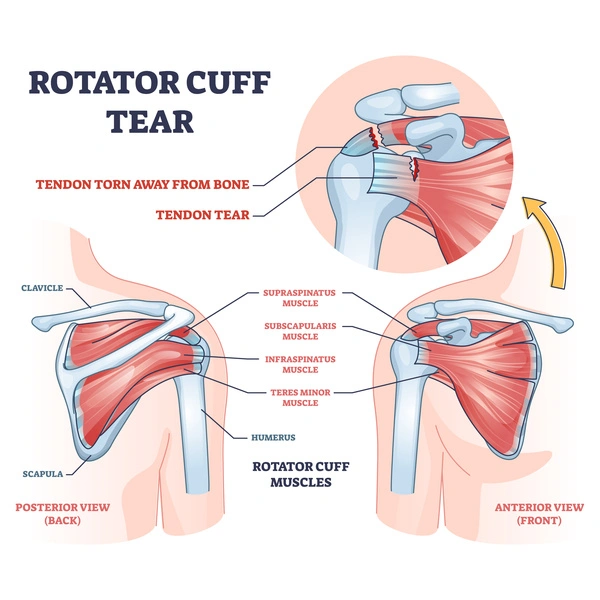
The rotator cuff is a group of four muscles and their tendons that wrap around the top of your shoulder joint like a cuff. The shoulder itself is a ball-and-socket joint, but the socket is very shallow, a bit like a golf ball sitting on a flat tee. The rotator cuff holds the ball of your upper arm bone securely in the socket.
It also helps you lift your arm and rotate it inwards and outwards. You use it in everyday activities such as reaching up to a shelf, brushing your hair, putting on a coat or reaching behind your back.
It is made up of four different muscles and tendons: collectively known as SITS:
Supraspinitus
Infraspinitus
Subscapularis
Teres minor.
Does a rotator cuff tear always cause pain?
A rotator cuff tear can be a painful injury but it won’t necessarily cause pain all the time.
For example, some people with rotator cuff tears will feel some pain when lifting objects, reaching upwards, or rotating the arm. Others may find that pain gets worse at night time – particularly when sleeping on the affected shoulder – while others with degenerative tears may not experience discomfort at all. Instead, they may simply feel a general weakness in the arm.
Extensive research has identified people with rotator cuff tears who report little to no shoulder pain. Some even experience no loss of function either. Indeed, one population screening study of 664 people found full-thickness tears in 22.1% of participants. Approximately two-thirds of the identified tears were found to be completely asymptomatic. The same study also found that there was a prevalence of asymptomatic tears in older participants.
Is the tear always the cause of shoulder pain?
While it’s tempting to assume that if a scan shows a rotator cuff tear, it must be the tear itself that’s causing pain. However, in practice, this often isn’t the case. In fact, for many patients it’s the subacromial bursa and the impingement process around it — not the tear itself — that’s the main source of pain and discomfort.
Reviews of the nerve supply to the shoulder joint have found that the subacromial bursa (the small fluid-filled sac that sits on top of your shoulder and cushions the space between the rotator cuff tendons and bone) contains the highest amount of nerve endings of any structure in the shoulder.
Put simply: the tissue most wired to hurt is this subacromial bursa, not the tendon. This fits closely with the clinical observation that bursitis and shoulder impingement – rather than the tear itself – are often the main driver of a patient’s symptoms.
Shoulder bursitis occurs when the subacromial bursa (the small fluid-filled sac that sits on top of your shoulder and cushions the space between the rotator cuff tendons and bone) becomes inflamed.
This can be from overuse, a reaction to a degenerating nearby tendon, or rubbing. When this happens, the bursa swells and, given its location in a very tightly confined space in the shoulder, this can cause pain.
The main consequences of this include persistent pain and restricted arm movement.
Shoulder impingement is a condition where the top of your shoulder blade rubs against or pinches the tendons of your rotator cuff. It can be very painful on the top, front, or outside of your shoulder with the pain increasing when the arm is lifted.
It is caused by a narrowing of the space between the rotator cuff and the shoulder joint. Repetitive overhead movements (e.g. swimming stokes or tennis serves) may aggravate the condition which leads to inflammation of the shoulder tendons or bursae.
Can a rotator cuff tear be treated without surgery?
While rotator cuff tears don’t repair on their own without surgery, in some cases, the injury can be treated with more conservative methods. If suitable for the specific patient, physiotherapy, pain injections, medication, rest, and making changes to physical activity all represent different options to try.
Of course, as mentioned previously, a rotator cuff tear may not be the cause of the shoulder pain. Shoulder bursitis (the swelling of the bursa at the top of the shoulder) can cause a great deal of discomfort due to the number of pain-sensing nerve endings it contains.
Physical therapy focuses on strengthening the other muscles in the shoulder around the damaged tissue. The aim is to improve and restore function to the joint by compensating for the injured tissue.
During consultation, your specialist will be able to recommend the best course of action for you based on an accurate diagnosis. A torn rotator cuff isn’t necessarily always the main issue when it comes to shoulder pain. It’s possible for the pain to be caused by shoulder bursitis or impingement and recognising the distinction helps set realistic expectations for treatment. It also helps to explain why addressing inflammation first, before considering surgery, is a good first step to take.
Can a steroid injection help a rotator cuff tear?
A steroid injection can help if you have a rotator cuff tear, but it’s important to understand what the injection does. The steroid doesn’t repair or heal the torn tendon. Instead, it reduces the inflammation and swelling around the tendon, which is often the main cause of pain. With less pain, you can usually do your physiotherapy exercises more comfortably and effectively. For many people this works well, and the shoulder returns to normal everyday use without surgery. In some cases, though, the pain comes back once the effects of the injection have worn off. If it does, this may mean the tear needs surgical repair. In the event this happens, your specialist will discuss your options with you.
Want fast access to healthcare?
Avoid long waiting lists. Book a private consultation today.
When might surgery be recommended for a rotator cuff tear?
Surgery for a rotator cuff tear may not be the only option. However, if the issue doesn’t improve over time or respond to more conservative methods, your consultant may recommend surgery.
The following isn’t definitive but lists the most common reasons that it may be time to seek surgery for your torn rotator cuff:
your job requiring reliable overhead strength or full range of arm motion.
Shoulder decompression vs rotator cuff repair
Occasionally, there’s some confusion over the difference between rotator cuff repair surgery and a shoulder decompression procedure. They are different operations with different objectives and recovery timings.
Shoulder decompression: a keyhole procedure that removes bone or soft tissue from the shoulder in order to reduce pressure around the rotator cuff tendons
Rotator cuff repair surgery: designed to repair (where possible) and reattach the damaged tendon to the bone.
The table below demonstrates the differences between the two shoulder procedures.
Feature
Shoulder decompression
Rotator cuff repair
Main aim
To create more space in the subacromial area and address tissues contributing to pain
To reattach the torn tendon to the bone
Does it repair the tear?
No
Yes, where the tendon is repairable
Typical surgical approach
Keyhole
Keyhole
Early movement
Often begins earlier because there is no tendon repair to protect
Usually restricted initially to protect the repair
Sling
May be used mainly for comfort, depending on the procedure
Commonly required for several weeks
Recovery
Often quicker than a tendon repair
Usually slower and requires structured rehabilitation
Main consideration
Does not restore the torn tendon
The tendon may not heal fully despite surgery
What is recovery like after rotator cuff repair?
Recovery after rotator cuff repair takes time and depends largely on:
the size of the tear
which tendons were repaired.
Larger tears are under more strain once repaired and need longer to heal. During the healing process, your surgeon will decide how long you need to wear a sling based on what was found during your operation. You‘ll usually need to wear a sling for 6-8 weeks to protect the repair while the tendon heals back onto the bone.
During this time your physiotherapist may get your started on some gentle exercises to keep the shoulder from stiffening without putting the repair at risk. Which exercises you do, and when you start them, will depend on the tendon that was repaired. Apart from these exercises, you should not use the arm to lift or reach, even if it feels comfortable.
Your rehabilitation programme will be based on your surgical findings and tailored to your specific needs. Once the sling is removed, your physiotherapy will gradually progress to restore movement and strength. Full recovery from rotator cuff repair can take several months, and it’s normal for the shoulder to keep improving for up to a year after surgery.
A word from Damien Tucker, Consultant Orthopaedic Surgeon
“A rotator cuff repair is not just an operation. It is the start of a long recovery that will have a real impact on your work, your family, and your everyday life. That’s why I believe the decision to repair a tendon must always be shared between surgeon and patient. I take time to understand what matters to you, so that together we can choose the treatment that is right for you.”
The amount of time you’ll need to take off work depends on the severity of your injury and the type of job you do. The sections below will give you an idea of when you can expect to be able to return to work after shoulder surgery.
Desk-based workers usually return to work earlier than those with more physical jobs. This is typically around 2-4 weeks after the operation.
If you are a desk-based worker, you’ll likely still be wearing your sling at this stage, so you’ll need to work mainly with your other hand. Typing and using a mouse with the arm that’s been operated on should be kept to a minimum. In fact, this arm should only be used within the limits your physiotherapist has given you. Make sure your chair and desk are set up so you can sit comfortably without reaching or raising your shoulder. Resting the arm on a pillow or cushion can help with this.
You may find you tire more easily at first, particularly if your sleep has been disturbed. With this in mind, a phased return or shorter days for the first few weeks can help. You should also think about how you will get to work, as you won’t be able to drive while wearing the sling. It’s worth discussing your return with your employer before your operation so that any changes can be arranged in advance. Your surgeon or physiotherapist can advise you on when you are ready to go back to work and provide a fit note if needed.
There’s actually no set time after shoulder surgery when you can start driving again. The DVLA states that you are responsible for making sure you can control your vehicle safely at all times. You shouldn’t drive while wearing a sling. This is because you need to be able to hold the steering wheel with both hands, turn it fully, and perform an emergency manoeuvre without pain.
Strong painkillers can also affect your concentration and reaction times. Most people return to driving around 6-8 weeks after rotator cuff repair, but your surgeon or physiotherapist will advise depending on your specific circumstances. It’s also recommended that you tell your insurance company about your surgery before you start driving again.
If your job involves manual work, you’ll need more time off than people who are desk-based. This is because the repaired tendon must be strong enough to cope with the demands of your job. Lifting, carrying, pushing, pulling, and working with your operated arm above shoulder height all put considerable strain on the repair. Doing these arm movements and actions too early can cause it to fail.
For lighter manual work, many people find they can return around 3 months after their operation. Heavy manual work or jobs involving repeated overhead activity usually require 4-6 months off. This can be even longer depending on the size of the tear.
Your return to manual work will depend on:
the size of your tear
which tendons were repaired
how your rehabilitation is progressing
Your surgeon and physiotherapist will advise you when the time is right. It’s a good idea to discuss with your employer whether you can modify your job responsibilities to include lighter duties. Doing so may allow you to return sooner while you continue to build up your strength. Your surgeon or GP can provide fit notes covering your time off and any adjustments you need.
Private rotator cuff treatment with Practice Plus Group
Rotator cuff repair surgery is available with Practice Plus Group privately and via the NHS at the following locations across the country:
Barlborough
Devizes
Emersons Green
Gillingham
Ilford
Plymouth
Shepton Mallet
Southampton.
If you’re seeking your treatment privately, with Practice Plus Group, you’ll have your initial consultation and surgery (if needed) at a time to suit you. Rotator cuff repair surgery costs £5,749 (plus £145 for your initial consultation).
All of your care – from consultation to recovery – is carried out by our expert consultant and nursing teams who possess decades of experience in the field of orthopaedics and shoulder treatments.
Choosing the right option for you
Private healthcare offers greater flexibility over when, where, and by whom you’re treated. In the vast majority of cases, the waiting times are shorter too, and with Practice Plus Group, prices are transparent.
Choosing private healthcare can make planned treatment easier to fit around work, family, and personal commitments. Options to access private treatment are self-pay, payments plans, or medical insurance.
Not yet found the information you’re looking for? Our private healthcare FAQs might be able to help!
No. Some full-thickness tears cause little pain or loss of function and can initially be managed without surgery. The need for treatment depends on the following factors:
whether the tear followed an injury
the degree of weakness in the shoulder
the size and severity of the tear
how symptoms affect daily life
whether non-surgical treatment has helped.
A specialist should interpret the scan alongside a clinical examination.
A complete tendon tear won’t reattach itself to the bone without surgery. However, pain, movement, and function can still improve through physiotherapy, activity management, and other non-surgical treatments. Successful treatment does not always mean that the tear disappears from an MRI scan.
A properly planned physiotherapy programme should be tailored to the type of tear, symptoms and current shoulder function. Some discomfort can occur as activity increases, but sharp or worsening pain should be discussed with the physiotherapist or treating clinician. At Practice Plus Group, all our treatment plans are designed to be tailored to each patient’s specific needs.
No. A steroid injection does not reattach or repair the tendon. It may reduce inflammation and pain around the tendon or bursa. This can make it easier to participate in physiotherapy. The benefits and duration of relief vary, and injections are not suitable for everyone.
Some degenerative tears remain manageable and cause little difficulty. Others may become larger or more symptomatic over time. The likely course depends on the tear, muscle condition, symptoms and demands placed on the shoulder. Seek reassessment if pain, weakness, or function worsens.
A surgical opinion may be helpful if you have persistent pain, substantial weakness, worsening function, or symptoms that have not improved with appropriate non-surgical care. Prompt assessment is particularly important after a sudden injury if you cannot lift the arm or develop new, marked weakness.
No. Shoulder decompression aims to create more room around the rotator cuff and address tissues that may contribute to pain. Rotator cuff repair involves reattaching the torn tendon to the bone. As a repaired tendon needs protection while it heals, rehabilitation after repair is usually more restrictive.
Many patients wear a sling for several weeks, but the exact period depends on the size of the repair, severity of the injury, the surgical technique, speed of recovery, and the surgeon’s recovery guidance. Your surgical team should explain when the sling can be removed and which movements are safe at each stage.
It depends on the procedure and your job. Someone with a desk-based role may be able to return sooner than a person who drives, lifts, reaches overhead, or performs heavy manual work. Discuss your exact duties with the surgeon before surgery and ask whether a phased return or temporary light duties could help.
A repaired tendon does not always heal fully, and a further tear can occur. The risk depends on factors such as the original tear size, tendon quality, age, general health and the demands placed on the shoulder. Following the rehabilitation plan is important, but it cannot guarantee tendon healing.
Acknowledgements and clinical review
This page has been medically reviewed and approved by Mr Damien Tucker, Consultant Orthopaedic Surgeon at Practice Plus Group Hospital. He is a GMC-registered consultant surgeon (GMC: 7095252), with over 17 years of clinical experience and is a fellow of the Royal College of Surgeons of England. Mr Tucker performs more than 360 procedures annually and specialises in upper limb conditions.
All content on this page is produced by the Practice Plus Group digital content team and clinically reviewed by consultant specialists to ensure accuracy, patient safety, and alignment with current UK clinical best practice. Content is approved under Practice Plus Group’s clinical governance framework.
Damien Tucker General Medical Council number: 7095252
This page is regularly reviewed and updated to reflect changes in clinical evidence, surgical practice, and patient safety standards. The last clinical review was completed on 9/6/2026, with the next review scheduled for 9/06/2027.
James Wood, Content Specialist
This article was co-written by Content Specialist, James Wood. Our Content Specialist, James, has been writing articles and blogs for Practice Plus Group since 2022. He has more than a decade of experience as a copywriter within a range of different backgrounds and works closely with medical professionals to deliver information that's easy-to-read and patient-focused.
Check if we acceptyour insurer
How to get started
1
Get referred – Ask your GP to refer you to us.
2
Confirm cover – Contact your insurer to check your cover.
3
Get authorisation – Ask your insurer for a code.
4
Get booked in – Contact us to book your consultation.